
Spice procurement guide
Buying Indian Dry Chilli: Whole, Stemless, Flakes or Powder?
Choose the form for your application, agree how quality will be measured, and request evidence for the actual lot before accepting an export quotation.
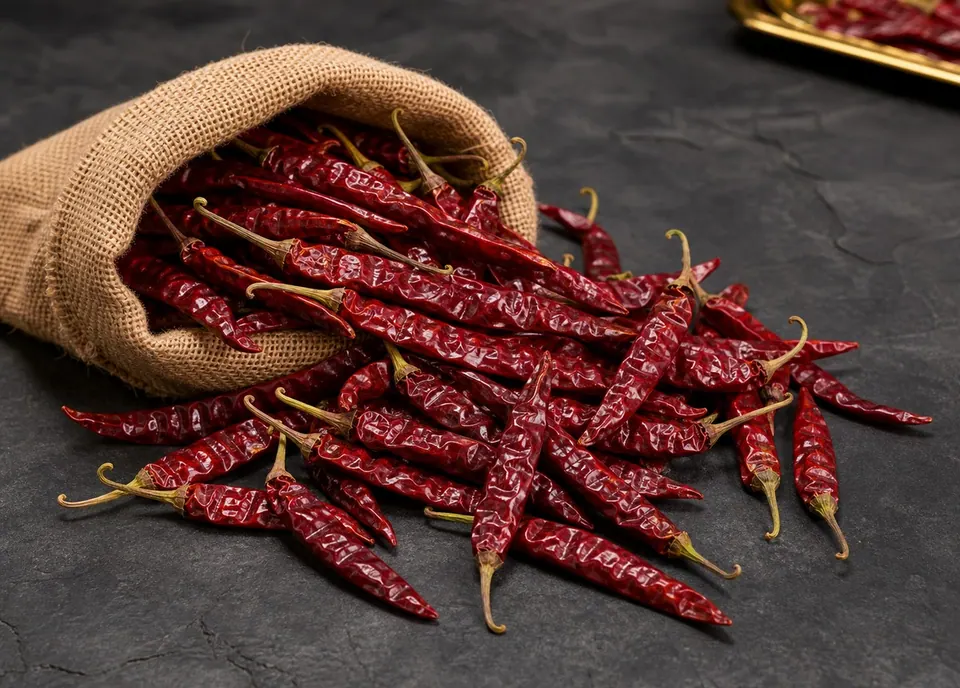
Start with the application and product identity
An importer buying chilli for a whole-spice shelf has a different brief from a sauce maker, seasoning blender or food-service distributor. State the intended use, whether further processing will take place, and the appearance or performance you need in the finished food.
Record the proposed trade name, botanical or varietal identity where relevant, growing origin and crop or production period. Our catalogue uses Samba / S4 terminology; confirm the supplier's exact identity and lot documents rather than treating a trade name as proof of origin, a geographical indication, heat level or certification.
Compare the forms without assuming one fixed specification
Use the following as procurement questions, not a promise of stock or a standard grade. Ask for a representative sample in the proposed form and agree how it will be compared with the eventual shipment.
- Whole with stalk: agree pod presentation, acceptable stalk content, broken material and visible-defect criteria.
- Stemless: define how stalk removal is assessed and whether other parts are retained; stemless does not automatically mean seedless.
- Crushed or flakes: specify the desired particle-size distribution, fines and seed content rather than relying on a photograph.
- Ground or powder: agree fineness, ingredients or blends, intended application and any required processing treatment.
Separate colour, pungency, moisture and particle size
A photograph is useful for presentation but cannot replace an agreed analytical specification. ASTA's methods catalogue distinguishes sample preparation, moisture, water activity, particle-size analysis and extraneous-matter testing. Specify the parameter, units, method edition and acceptance criterion for each requested result.
Ask the laboratory or processor to identify how colour and pungency are measured. A colour target should not be used as a heat specification, and a variety name should not substitute for a lot result. Decide who draws the sample, how it is identified, and how a disputed result will be reviewed.
References: ASTA: analytical-methods catalogue; Spices Board: laboratory evaluation parameters
Include the pungency-method edition in the buying brief
ASTA published a 2026 revision of Method 21.3 for HPLC pungency measurement, updating capsaicin response factors from the 2004 version. Its notice describes a five-year phase-in with official implementation in 2031.
When comparing a historical specification with a new report, ask which edition and calculation basis were used. Agree the reporting basis before comparing numbers; do not assume different method editions are interchangeable. This is a procurement check, not a statement that Jayshree's chilli has been tested to either edition.
References: ASTA: Method 21.3 (2026) pungency update
Connect safety and authenticity evidence to the actual lot
The Spices Board's published laboratory-parameter list includes aflatoxins, pesticide residues, synthetic dyes, microbiological tests, moisture and water activity. That page's parameter content is dated 2015: it is a useful testing vocabulary, not a current destination-specific legal limit, mandatory test panel, fee or turnaround commitment.
Ask the importer and qualified technical team to establish the current applicable requirements for the exact product, origin, destination and intended use. Request the relevant lot-linked reports, sampling identity, methods and acceptance criteria. A laboratory offering a test is not proof that a particular lot passed it; a general licence or certificate is not a substitute for the required consignment evidence.
References: Spices Board: laboratory evaluation parameters
Agree packing, treatment and arrival acceptance together
Specify the inner and outer pack, target fill weight, label language, lot/date coding, handling conditions and arrival window. Ask who performs any cleaning, grinding, treatment or packing and which documents relate to that selected facility and product.
Confirm the proposed storage and shelf life from the actual processor's evidence. Agree sample approval, retained samples, arrival inspection, claims handling and responsibility for any further processing before the order. We do not publish universal moisture, heat, pack, MOQ, treatment or shelf-life promises in this guide.
Send a complete enquiry rather than only a product name
Share your target specification or ask which points still need to be agreed. Additional forms, custom packing and private-label requests can be reviewed for technical feasibility with the selected supplying facility; availability and shipment eligibility are confirmed for the actual arrangement.
Use the checklist below with the chilli catalogue or export desk. The contact options prepare a message in your own application; opening a draft does not mean an enquiry has been sent or received.
Procurement checklist
Dry-chilli enquiry checklist
- Product and trade name; whole, stemless, crushed/flakes or powder form
- Intended application and any further processing
- Destination country, port, importer and arrival window
- Target colour and pungency, with test-method edition and reporting basis
- Particle-size, stalk/seed and visible-defect acceptance criteria
- Required safety/authenticity parameters and lot-linked evidence
- Required treatment, supplying processor and facility-specific documents
- Pack and fill-weight preference, label language or private-label brief
- Order volume, repeat frequency, sample approval and arrival acceptance
Common questions
Buyer FAQ
Is stemless chilli the same as seedless chilli?
No. Specify stalk removal and seed content separately and confirm the proposed form against a representative sample and agreed lot specification.
Can I choose chilli flakes by mesh size alone?
State the intended application and agree particle-size distribution, fines, seed content and a measurement method. A single size label or photograph may not define all the buyer's acceptance criteria.
Does an ASTA method reference mean the product is ASTA certified?
No. A method reference identifies how a parameter may be measured. Ask for the actual laboratory report, lot identity, method edition and agreed acceptance criterion; it is not a company or product certification claim.
What heat level, shelf life and MOQ does Jayshree guarantee?
No universal values are promised here. Confirm the exact product identity, selected lot, processor evidence, packing, order and destination with the export desk before accepting a quotation.
Sources and verification
Consult the official source for current requirements. Shipment eligibility and product specifications must be confirmed for the actual origin, destination and supply arrangement.
- ASTA: analytical-methods catalogue
Checked 22 October 2026. Separate parameter/method references, not proof of supplier testing or certification.
- ASTA: Method 21.3 (2026) pungency update
Official revision notice reviewed 22 October 2026; phase-in to 2031. No numerical product heat claim or independent method validation.
- Spices Board: laboratory evaluation parameters
Checked 22 October 2026; parameter content dated 18 November 2015. Historical vocabulary only, not current testing fees, mandatory panels or destination limits.