
Pickled ingredient guide
Gherkins and Jalapeños: Cuts, Brines and Packing Formats
How importers and food-service buyers can specify cut, brine, pack size, label and end use before requesting a quotation.
Start with the menu or manufacturing use
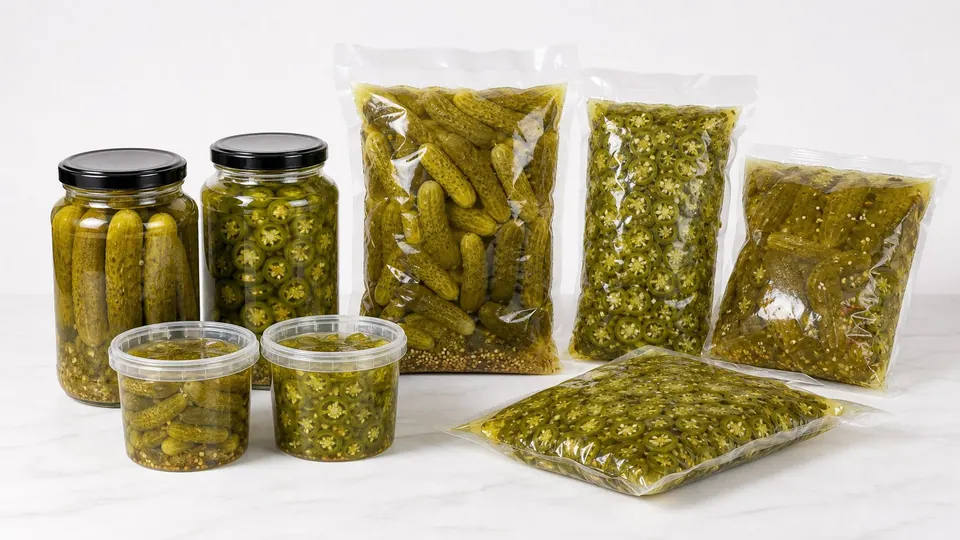
Whole gherkins can be considered for table service and retail presentation, while sliced forms can suit burgers, sandwiches and sauces. The catalogue shows whole or sliced gherkins; diced and other customised cuts are enquiries subject to the selected supplier's specification, technical feasibility, minimum quantity and current availability. Sliced jalapeño rings are listed for topping, sauce and food-service enquiries.
The intended use determines cut consistency, drained weight, heat profile, pack size and handling format.
Specify product and brine together
A useful specification covers variety or grade, size, cut dimensions, texture, colour, flavour, heat level, brine composition, drained weight and permitted additives. Product and brine should be assessed as one system because both affect the finished application.
- Whole or sliced gherkins; identify diced/custom cuts as requests
- Sliced jalapeño rings
- Cut dimensions and size grade
- Brine, flavour and heat profile
- Net weight and drained weight
Select packing by channel
Compare the offered jars, food-service packs and pouches against the way your operation opens, drains, portions and stores the product. Confirm the actual net and drained weights, closure, case count and handling instructions rather than assuming every pack is interchangeable.
Agree label text, ingredient and allergen declarations, lot coding and pallet requirements with the importer. A picture of a pack does not establish its current availability, formulation or validated shelf life.
Confirm food-safety and import documentation
Before production, buyers should confirm product tests, shelf-life expectations, coding, allergen and ingredient declarations, destination labels and required certificates. The final document set depends on product, market and customer program.
Confirm preservation, storage and the relevant processor records
For products intended for the United States, have the supplying processor and qualified importer determine whether the actual formulation, process and container fall within the shelf-stable acidified or low-acid canned food regime. FDA describes establishment registration and product/process filings for relevant commercial processors. These obligations are not proved by a generic food-business certificate or the word 'pickled' on a label.
Agree the preservation process, lot identification, net and drained weights, validated storage and shelf life, and handling after opening. Request the actual container and product documentation. This guide does not confirm industrial drum formats, ambient storage or a filing status that is absent from the approved supply specification.
For a proposed US supply, match any relevant establishment and process records to the actual processing location, product, style, container size and type, and processing method. Obtain confirmation through the selected processor and importer rather than treating a record for another pack or site as interchangeable. These processor-specific records are distinct from a generic company credential; they do not by themselves establish all import requirements or approval of a shipment.
References: FDA: acidified and low-acid food regulations and guidance; FDA: establishment registration and process filing
Distinguish finished pickles from ingredients for further processing
APEDA distinguishes provisionally preserved gherkins for later repacking from preserved-in-vinegar consumer products. Establish which product you are buying, its intended use and the processing still required. Do not assume a bulk preserved ingredient is ready for direct service.
Its commodity page names the USA, Germany, Russia, Canada and France as major importing countries. This is industry context—not proof of Jayshree shipments, approved supplying facilities or current market access. Confirm destination requirements for the exact gherkin or jalapeño product; the two commodities are not automatically equivalent.
References: APEDA: cucumber and gherkin commodity context
Procurement checklist
Information to include in a pickled-product enquiry
- Gherkins, jalapeños or a combined program
- Whole or sliced gherkins or jalapeño rings; separately identify any custom diced-cut request
- Retail, food-service, QSR or manufacturing use
- Size grade, cut dimensions and heat profile
- Brine, ingredient and additive requirements
- Net weight, drained weight and pack preference
- Label, coding, carton and pallet requirements
- Destination tests, certifications and documents
- Actual preservation process, unopened/opened storage and applicable processor documentation
Common questions
Buyer FAQ
Which gherkin formats are listed, and which require a custom request?
The catalogue shows whole or sliced gherkin presentations in jar and bulk-pack formats. Diced cuts and other custom requirements are requests, not confirmed stock; review technical feasibility, minimum quantity and availability with the selected supplier. Agree grade, recipe, net and drained weights and pack before ordering.
Are sliced jalapeños available in food-service packs?
The catalogue lists sliced jalapeños and several packing presentations. Ask the export desk to confirm the actual food-service pack, formulation and current quantity; the listing alone is not a stock or shipment commitment.
What should a buyer specify besides pack size?
Specify cut, grade, heat or flavour profile, brine, drained weight, ingredients, label, coding, application, expected volume and destination requirements.
Does a jar or pouch determine shelf stability or the applicable import regime?
No. Establish the formulation, process, container and validated storage conditions for the actual product. Destination rules and any relevant processor records must be checked separately; packing style alone does not settle those questions.
Sources and verification
Consult the official source for current requirements. Shipment eligibility and product specifications must be confirmed for the actual origin, destination and supply arrangement.
- FDA: acidified and low-acid food regulations and guidance
Rechecked 16 October 2026. US-specific context; applicability depends on the actual formulation, process and container. No selected processor or shipment compliance verified.
- APEDA: cucumber and gherkin commodity context
Rechecked 16 October 2026. Industry product distinctions and destination context only; not a Jayshree pack specification, certificate or shipment approval.
- FDA: establishment registration and process filing
Reviewed 16 October 2026. Processor/location/product/container/process distinctions; not evidence of this supplier's filing status or all US import requirements.